
When people first hear about occupational therapy, they often assume it is only related to jobs or workplace injuries. In reality, it is a broad area of care focused on helping people perform the daily activities that matter most to them.
Those activities can include getting dressed, preparing meals, writing, bathing, using tools, returning to school, or managing routines at home. Because the term can sound technical at first, many people have similar questions when they start learning about it.
What does this type of care actually help with?
One of the most common questions is what this service is meant to address. Occupational therapy helps people improve or regain the skills needed for everyday living. That may involve fine motor coordination, balance, strength, sensory processing, cognitive skills, or adaptive strategies that make daily tasks more manageable.
The focus is usually practical. Instead of treating movement in isolation, care is often tied to real-life functions. A child may need help developing handwriting or self-care skills. An adult recovering from surgery may need support using the hand and arm more effectively. An older adult may benefit from guidance that makes home routines safer and easier to maintain.
Who might benefit from it?
Many people are surprised by how wide the range is. This kind of support can help children, adults, and older adults with very different needs. Some people receive care after an injury, illness, stroke, or surgery. Others may need help managing developmental delays, neurological conditions, chronic pain, arthritis, or sensory challenges.
Occupational therapy is often useful when a person can technically complete a task but has trouble doing it safely, comfortably, or consistently. For example, someone may be able to get dressed but struggle with buttons, balance, or joint stiffness. Another person may have difficulty concentrating long enough to complete schoolwork or routine household tasks. In those situations, the goal is to improve independence in ways that are realistic and meaningful.
What happens during an evaluation?
An evaluation usually begins with questions about daily routines, limitations, health history, and specific goals. The therapist may ask what activities feel difficult, what has changed recently, and which tasks are most important to improve. That conversation helps shape the rest of the plan and keeps the process centered on the person’s actual needs.
The therapist may also look at range of motion, coordination, strength, sensation, posture, attention, memory, or problem-solving, depending on the concern being addressed. In some cases, the evaluation also includes observation of how a person completes a daily task. That gives the provider a clearer sense of where the barriers are. Rather than using a generic routine, the therapist builds care around the skills that will make the biggest difference in daily life.
What does a typical session look like?
Another frequent question is whether treatment feels like exercise, practice, or education. In many cases, it includes all three. Sessions are often hands-on and activity-based. A person might work on grip strength, reaching, dressing techniques, visual tracking, memory tasks, or adaptive equipment that makes a routine easier to complete.
Occupational therapy sessions are usually tailored to the stage of recovery or development. Early sessions may focus on protection, gentle movement, or basic task completion. Later sessions may focus on endurance, coordination, routine building, or more advanced daily activities. A child may work through play-based tasks, while an adult may practice skills tied directly to cooking, driving preparation, office work, or self-care. The methods can vary, but the overall goal remains practical function.
Is it only for permanent conditions?
No. That is another common misunderstanding. Some people need short-term help while recovering from a fracture, surgery, or illness. Others may benefit from longer-term support for conditions that require ongoing adaptation. The length of care depends on the reason for treatment, the person’s goals, and how much progress is made over time.
It is also important to know that progress does not always mean returning to a previous level in exactly the same way. Sometimes success means learning a safer method, using a supportive device, or reducing fatigue during necessary tasks. Improvement can take different forms, and a good plan recognizes that function is not always about doing something the old way.
How do you know whether it is the right fit?
People often know they need help, but they are not always sure what kind. A useful sign is when a physical, cognitive, or sensory issue begins interfering with normal routines. That might mean trouble with dressing, meal preparation, school participation, hand use, organization, or home safety. When daily tasks become harder than they should be, a professional evaluation can help clarify the next step.
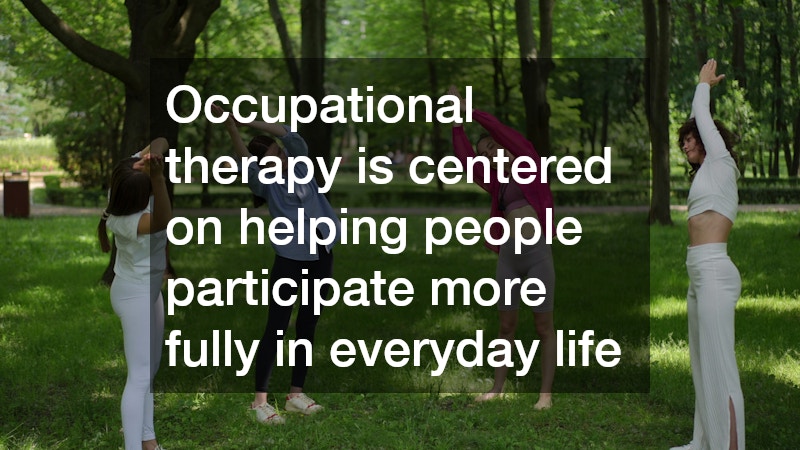
Occupational therapy is centered on helping people participate more fully in everyday life. That is why it continues to be such an important part of rehabilitation and supportive care. Whether the goal is greater independence, better safety, improved coordination, or more confidence with daily routines, this approach is designed to connect treatment directly to real-world function.